Monday, April 29, 2013

MYST- Memento

Memento (2000) Poster  So we watched the first part of this movie in class last quarter, but some of you may not remember the plot. Here is a quick summary: A man named Lenard has a mental condition where he is unable to make new memories and he is trying to find the man who murdered and killed his wife. We view the first half of the story in black in white going forwards, and the second half in color going backwards, ending at the starting point of the last scene. This creates a lot of mystery and confusion on what is going on as well as defining the morality of all the characters. The story takes a crazy amount of twists and terns, by the end of the movie you will be scratching your head but you will be sufficiently satisfied in you movie experience.

This is a Christopher Nolan film, who also did the Dark Knight movies and Inception. This movie was very intriguing in terms of cinematic qualities and character development. I have now watched the movie two times and I have picked up on so much more, not only in the plot but also in what Nolan does with the camera. Something that caught my attention this time was the tight camera work the entire way through the film. We only see a long shot 2 or 3 times the entire movie. This choice actually plays up the intensity of the film because we seem to experience everything as Lenard does, we never can see the whole picture. This theme is also highlighted by the color scenes that run backwards. Just like Lenard we have no idea how we get to the place in which this scene is starting.

As was mentioned in class this does have a lot of Film Noir elements to it. All of the characters have done something wrong in some way. Even the guy who manages the motel checks him into two rooms because Lenard can't remember. The black and white scenes add a lot to the Film Noir feel and it also has the post modern style of many truths. But I think the most notable and obvious feature of the movie is the femme fatale. I will spoil this for anyone who actually is interested in seeing the movie, so stop reading if you think that you might actually see this film. The girl who is the femme fatale you think you trust because the first four scenes that you see her she is nothing but loving and helpful. So when she turns on him and says to his face that his wife was a whore and that she is going to enjoy taking advantage of him because he is such a freak, you are blown away by how much of an absolute B***h she is.

Overall, it was mind-bending, action packed, confusing, philosophical and thoroughly entertaining. I would recommend having the clicker on hand just in case you miss some dialogue. Almost everything they say is deceptively important.  The acting is fairly good across the board, which is good because there are only 5 or 6 significant  characters in the entire thing and one bad actor would more than likely ruin it. I give it 4.5 stars out of 5.

Sunday, April 28, 2013

Formal Film Study Vietnam War Films


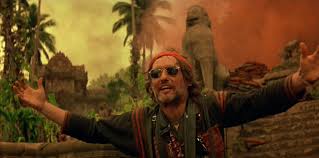
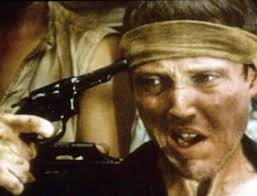
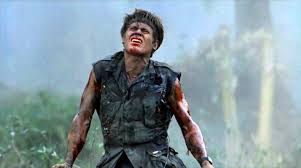
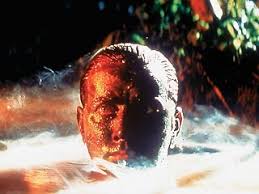
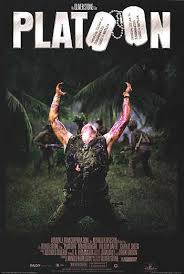
I picked three films that I had heard were all very good in their own way. Apocalypse Now, The Deer Hunter and Platoon. All of them had star studded casts and all of them had won many Academy Awards, and all of them were very disturbing. Now personally I thought that the Deer Hunter and Apocalypse Now were better films than Platoon because I think they did a lot more with cinematography and they had a more enjoyable story because they were much longer. Some things that connected these films were their political stance on the war and the way each film used sound to enhance the film.

First a quick summary of all three movies:

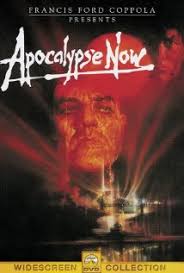
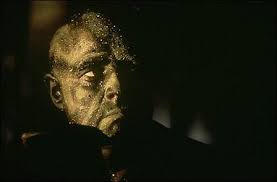
Apocalypse Now: The Protagonist Capitan Willard (Martin Sheen), is sent on a mission up the Nung River to eliminate an insane Colonel Kurtz (Marlon Brando). The story follows him on his wild adventures with his team to find Kurtz. Things become stranger and stranger the farther they go. Other big actors are Harrison Ford, Laurence Fishburne, and Robert Duvall. It won the Academy award for sound and cinematography.
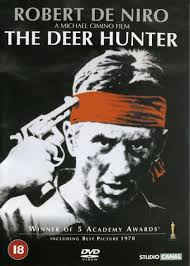
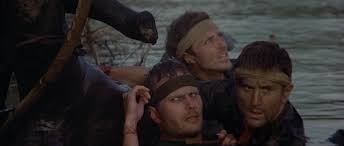
The Deer Hunter: We follow a group of friends before, during and after Vietnam. They experience a lot of emotionally shocking things in Nam and have struggles readjusting following service. The Leader Michael is played by Robert De Niro and the best friend Nick is played by Christopher Walken who won the Academy Award for best supporting actor for this role. Other Academy Awards were Best Picture, Best Director (Michael Cimino), Best Editing, and Best Sound.
Platoon: We follow a year of service in Nam by our protagonist Chris (Charlie Sheen). After losing some men the Platoon has a civil war with itself over who they should follow, the honorable Elias (Willem Dafoe) or the dirty Barnes (Tom Berenger). Things go to hell when the men are more focused on who to kill in their own Army and not the VCA. It won the Academy Award for Best Picture, Best Director (Oliver Stone), Best Sound and Best Film Editing.
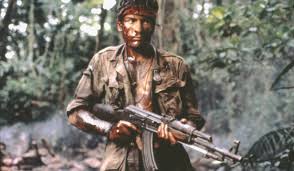
Each movie either through dialogue or cinema said something about our Nation and the war. All of these movies were against the war certainly, which makes sense because they are all post 1975. Each have different arguments against the war. In Apocalypse Now there is a lot of dialogue and events that make the war seem ludicrous and that the Americans have no purpose to their fighting. For example, Robert Duvall’s character Kilgore is trying to surf in the middle of an attack on the VC. This kind of shows that the American soldiers were not fighting for something they believed was important. As we move farther and farther up the river less and less people are in charge. No CO’s are found and people are killing with no direction. At one point Playboy Bunnies give a show for the USO that ends in a sexual riot by the Soldiers trying to get at the girls. After that a voice over by Capitan Willard again showed that the Americans weren’t going to win because they didn’t have enough drive to fight. “Charlie didn’t get USO. His idea of R and R was cold rice and maybe some rat meat. He had only two ways home, Death or Victory.” And then during the visit to the French Plantation where we see the owner explain why the French don’t want to leave. They built the place into a civilization. They had lived there for hundreds of years and they called it home. But the Americans were fighting for nothing but control over people’s minds which he says is impossible.
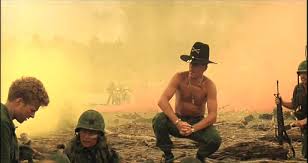
 
In the Deer Hunter, we see that Americans do not understand how hard the war was on those who were actually in it.  They didn’t understand that these are not the same people they were when they left even physically but more so mentally. All of this is mostly through action shots and is aided by the lighting in certain scenes. When Michael first returns, he skips seeing all his friends and stays at a motel instead because he is unable to be happy at that moment, with his concerns about Nick and Steve. Then again when Michael flips out on Stanley in the woods because of the pistol he carries around. We see it in Steve when he refuses to leave the hospital for wounded warriors and he refuses to see his wife and child. And worst of all Nick, who is still in Saigon unable to cope with the amount of trauma that he has been through. The other criticism is that American excitement over sending our boys to war is foolish. Pre war we get almost an hour of Patriotic people at a wedding before the boys go off to war. But after all the intense things that happen in Vietnam that same Patriotism is there and it looks absolutely silly.
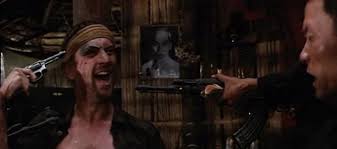
  
Platoon is not as focused as the other movies on the issues of the Vietnam war. Platoon has a lot to say about what is wrong with our military. There is a scene of dialogue about how the people who are fighting for this society are given nothing by this society. They have no jobs waiting for them at home, most didn’t graduate high school and almost all of them are poor.  The lowest people on the totem pole go to war but they have the least to fight for. It talks about how rich people always screw over poor people and they always will. I thought that that was a different take on the war and why it was bad. Money isn’t mentioned in the other two movies so it jumped out at me when he said it.
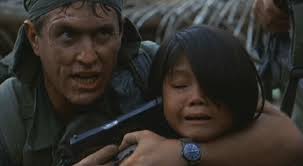
 
The one film element that stood out to me in all three films, also stood out to the Academy. All three movies won the Academy Award for best sound in their respective release year. All of them manipulate sound and music extremely well. In Apocalypse Now, the strange high pitched whine every time something strange is occurring gives the audience an uneasy feeling. It makes everything seem chaotic and dangerous. Perhaps the best use of sound is during Willard’s final encounter with Kurtz, you have this wild song by the Doors playing, Kurtz final recording “We train men to drop fire on people, but their officers won’t allow them to write fuck on their Airplanes because it’s obscene”, and then a tribal chant from a ritual being performed outside. It creates this feeling of total anarchy and chaos. Then it all cuts out as we hear Kurtz’s famous final words echo in the temple “the horror, the horror”.
  
In the Deer Hunter it was the music following Vietnam. After watching Russian roulette and people explode, the action moves back to Michael returning to the states. The music is this nice soothing piano with pleasant harmonies. The reason that this is so effective is because it gives the audience the same experience that Michael is going through. Jumping from high intensity music and action to soothing music and shots of small town America are too different. It doesn’t feel important or really filling because all of our minds are still in Vietnam just like Michael’s. Platoon’s sound really does a great job of helping the audience experience the anxiety and stress that a soldier in Nam would go through. When the action is in the jungle something is always happening in the sound, we always here shots or explosions or even just the sound of vegetation moving.  You always feel like something big could happen at any second. The sound creates this constant sense that so much more is happening than we can see. That must have been how soldiers felt in the thick jungle when they heard leaves move or shots in the distance but having no idea who caused them.
  
The final thing that I think should be noted about these films is that they range in believability. Apocalypse Now would never happen ever. It’s way too far fetched to think that this could actually happen. The Deer Hunter has some parts that are very unlikely but are still plausible, but it still feels very fictional. Platoon makes you feel like you experienced what war really was like in Vietnam. A lot of waiting, a lot of pain and anxiety, and a lot of displaced hostility. But overall I think everyone should see these three fantastic films. 

Wednesday, March 20, 2013

MYST-Casablanca

Casablanca tells the tail of an American man played by Humphrey Bogart, who own a bar in Casablanca. This place is the hot spot in Morocco for all of the people looking to escape the horrors in Europe, fly to Lisbon and then to America. The Nazis currently control the people who get in and out of Morocco, so most of the refugees are stuck. Then a famous French escapee of the concentration camps and his wife turn up (Ingrid Bergman). Bogart's character has an unknown past with Bergman, as she asks to get her and her husband out of the country. Its a love story that is also very political in nature, with each character representing the politics of their birth nation. 
This is probably Bogart's most known performance and in my opinion one of his best. Although he is great in the African Queen and iconic in The Maltese Falcon, in Casablanca Bogart plays a very complex character who represents America's political stance during world war two. Also, he has so many memorable lines in this movie that are still used and quoted today. I think those two features make this performance one of his best, and probably one of the best of all time. 
Now one of my  favorite scenes from this movie is a little cheesy but still moving. At one point the Nazis are singing a German song in the bar in front of these French refugees. Then the French escapee asks the band to play the French song "Les Marseillaise". The band looks at Bogie and he gives them a nod. Then the band plays it and the whole crowd stands up and sings until the Germans sit down. It is a beautiful metaphor for how the Americans acted in the war, and how the war would turn out if the Americans helped. 

I thought it was great. 5/5 stars.

Thursday, March 14, 2013

1935 Hooked on You

1. Synopsis: Essentially, our lead played by Frank Sinatra is the son of an immigrant in New Jersey. He falls in love with the daughter of an immigrant played by the wife of Harry Cohn. Sinatra is very sleezy trying to get this classy girl. Then after that Sinatra looses his hand and it is replaced by a hook. Then in the end she falls in love with him despite his disability and the morale is to treat people with disabilities and immigrants better.
2. Genre: Musical Drama, we wanted to have more than just songs to entertain.
3. Studio: We chose Columbia because we really wanted to have Frank Capra direct because he is my personal favorite from this time period. Also, this gave us the excuse to use Cohn's wife as an actress.
4. Cast and Crew: We all liked Capra because we liked his style and he also could be our cinematographer which was nice. We took Joan Perry, Cohn's Wife, because she would be something that Cohn made Capra do as a gesture of loyalty almost. So then we decided on Sinatra because he is the son of a Sicilian immigrant and Capra is from Sicily. It all made sense, putting people into each of these roles. Also, this is early in both Sinatra's and Capra's career,  so it seemed like a good match in that sense as well.
5. Hays Code/ Technology: We decided that it would be better to have a hook hand instead of just a stump because that might offend some people at the Catholic Legion of Decency. Also, Capra would show his fluid camera style in this movie with lots of swooping shots.
6. Changes: We argued a lot about the plot, I wanted it just to be a money maker to start Capra's career before he did his other works. Kevin wanted it to be called Opium Den and have it be all about junkies and Harry wasn't wild about the idea of a musical. We all figured it out in the end but I don't love that it isn't a pure musical thing and that they only sing three time. Sinatra's appeal is in his looks and voice, he is a pretty poor actor so this movie might have been a complete bust.

Tuesday, March 5, 2013

FFS- Scorsese


Martin Scorsese is no doubt one of the greatest film makers of all time based on awards, critiques and film fans alike. Three of Scorsese’s films made it onto the American Film Institute’s “The 100 Best Films of All Time” list (Taxi Driver, Raging Bull and Goodfellas). Now obviously many things make him a great, his plots are deep and enthralling, he always seems to get the most out of his actors and his staging of shots are unbelievably good. However of all of the things Scorsese does well, I am going to talk about his use of lighting and staging of shots in Raging Bull, Taxi Driver and The Departed.

Now the focus/point of all three films are very different however Scorsese uses the same elements to achieve these effects. In Raging Bull, the point is to depict the emotional trauma of Jake La Matta’s life. Taxi Driver deals with social issues of Prostitution, Mental health, and the scum that inhabits the night life in the rough parts of NYC. And The Departed shows the workings of organized crime and the holes in our justice system.

Scorsese’s use of shading and lighting throughout all of his works is more than just a way to depict the emotions in each scene; they display deeper meanings in the overall theme of the story. I think that the most evident of these is in The Departed. In the final shot we see the justice building of Boston glowing in the vast sunlight and a rat on a rail covered in shadow perfectly in line with the dome of the building. In a story all about rats in crime and the law, its sums up the movie. But the lighting ads more than that, it becomes slightly political in nature just based on the shading. We see the Police as a place that stands for clean, wholesome, law-abiding people by definition. Hence the building is bathed in sunlight. However, organized crime doesn’t survive without rats in the government and that is what you don’t know about. The rat is bathed in shadow, hidden from plain view. Light is also probably the most important feature of Raging Bull. Probably some of the most obvious is Vicky especially early in the film. Everything about her is white when she first appears, from her hair to her dress to the bed that Jake seduces her on. This highlights her youth, her innocence and her standing in Jake’s mind as the girl who “you don’t just bang and forget about”. But let’s not forget Taxi Driver and all of its focus on night and day. Just as Travis says everything comes out at night. The strange red lighting during his conversations at night, when his mental state is rapidly deteriorating, is to alert the viewer of the way that this conversation is actually affecting him.


Now, let’s look at Scorsese staging in each film. In Taxi Driver, when Travis goes to see Palantine arriving in his limo and he talks to the Secret Service man, Scorsese stages the shot so perfectly to emphasize Travis’ lack of appeal and his inability to fit in society. He has an inspiring campaign poster of Palantine in the foreground, a very tall clean cut Secret Service man in the middle ground, and an awkward Travis looking very undersized and uncomfortable in the background. This shows the importance of each of these characters but also the roles and their importance in the mind of Americans. People like Senators are talked about all the time, government looks out for your average Joe but little attention is given to those like Travis who really need it. In The Departed we have so many of really interesting shots but the two I want to focus on are of Damon before he enters the force and just after Nicolson dies. In the first shot Damon is inside a circle, the circle then expands out to show Damon alone outside with a lot of sunshine in the center of the street in the city of Boston.  The second time we see Damon alone in the dark in his office with busy people crossing back and forth with many things around him, the shot then moves to the circle we first saw him in at the beginning. The flipping of these shots is ironic because at that time in the movie Damon has a lot of support, in fact he has the entire mafia behind him. But in the final shot he is all alone, the leaders of the mob have been killed and the only tie to the organization he just burned. The shot symbolized not only the switch of him standing alone among the mob to being just another cop but also his incredible isolation now. 

Monday, February 11, 2013

MYST - From Russia With Love


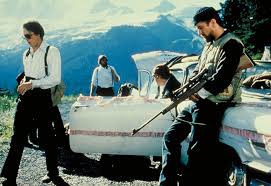
From  Russia with Love is 1963 Bond movie starring the original Bond, Sean Connery. I thought that it was fairly good in terms of dialogue and plot, however some of the acting is poor and a majority of the special effects are very dated. One thing that did catch me off-guard with this movie is the amount of sexuality, in almost every scene there is a reference or a sexual tone displayed. 
The acting done by Connery is absolutely fantastic, this is the first film I have seen him in and now I understand why he should be the only Bond. He is silky smooth, quick witted and full of unshaken confidence. Although I found Daniel Craig's rugged version of Bond to be entertaining in Casino Royale and Skyfall, he becomes more of a soldier than a secret agent. Connery's Bond seems to prefer out smarting his opponents while Craig seems to use brute force. Connery's version just seems to fit the character of a secret agent much better than Craig's. 

One of the only flaws is that the female lead, despite being very easy on the eyes is pretty brutal as an actress and her character is very poorly written. At point she hopelessly over acts her love for James, even though she met him a day ago. Then her character altogether is fairly weak and slightly dim witted which is a let down. Compared to Eva Green's character in Casino Royale who is perhaps more witty than James creates interesting dialogue and character development that is lacking from From Russia with Love. 

The camera work is pretty much by the books but it works really well in the majority of scenes. For instance in the scenes involving the master criminal, we never get a look at his face only of his cat that he is holding in his lap. During these scenes they are on a boat because it allows them to have the shot tilt like a boat rocking in the sea. However, the tilted camera gives a subtle dutch angle to know that the plot is evil and diabolical. The only thing that would have made the scene better would have been more interesting lighting, because all of the actors are lit with the same amount of light. 

Overall I enjoyed it, pretty entertaining, I give it 3 and 1/2 stars out of 5.

Thursday, January 31, 2013

Review of the Reviews


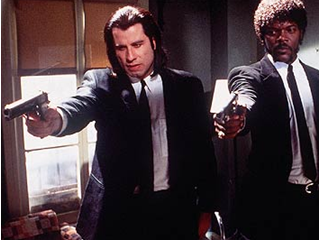
Pulp Fiction

Positive
By Desson Howe
Washington Post Staff Writer 
http://www.washingtonpost.com/wp-srv/style/longterm/movies/videos/pulpfictionrhowe_a01b66.htm

NegativeBy Stanley KauffmannNew Republic Critic
http://www.newrepublic.com/article/film/shooting#

Howe's review is organized so that the his opinion of the movie is the first piece of information given to the reader. He then continues on to talk about the acting, plot and writing. He is very quick and to the point with his information, however he does make a lot of references to other directors and other movies which is hit and miss with its potency. The review is very lighthearted and positive which ironically contrasts with the nature of the film. His main focus is actually on the director. Howe states that although his last two movies are  great films they are very similar in subject and he should avoid this topic to stay fresh.

Kauffmann's review doesn't talk about his opinion of the movie until midway through the review, he spends the first half talking about who Tarantino is and his life story. The author uses really long winded statements to reach fairly mute points, which makes the entire thing very hard to read. Also, most of his strikes against the movie are because of minor errors, two of which don't actually exist, or that the movie that has "fiction" in the title is slightly far fetched. He does make lots of references but they were to books that I have not read. His over focus is on how awful Tarantino is as a director but it comes off as fairly weak in its criticisms.

I agree with Howe.“PULP FICTION is everything it’s said to be: brilliant and brutal, funny and exhilarating, jaw-droppingly cruel and disarmingly sweet. Quentin Tarantino, the postmodern Boy Wonder of American crass culture, for whom the only thing to fear is boredom itself, has produced a work of mesmerizing entertainment. To watch this movie (whose 2 1/2 hours speed by unnoticed) is to experience a near-assault of creativity."  I really enjoyed the movie because it constantly provoked me and kept me on the edge of my seat during every scene. All of the dialogue was quick and witty and very funny. The acting was great by everyone in the cast which is rare. Plus the overall structure of the plot actually adds to the depth of the movie because every scene is disconnected from the next either because of time or characters, but they all weave together by the end to create a linear plot.


Again Howe's would be more convincing. He is quick to the point with each of his praises and slight criticisms where as Kauffmann takes a paragraph for each of his criticisms. This is key for me because if I want to read a review of a movie I don't want to find out the entire plot and back story of the director before you tell me if you think it is good or not. A review is supposed to be I thought-x because of-y, not a three page paper. I think it is valid points of praise or criticism based on fundamental parts of the film. Saying a movie sucks because it has a clerical error is kind of like saying the "I Have a Dream" speech by MLK sucks because he doesn't use perfect grammar. They are very minor in comparison to everything else in the film.

If I were to write a review of a film, I would keep it short and to the point. All I am doing is putting in my two cents, I am not writing a thesis paper on the movie. Also, all of my points would be about major factors to the film such as acting, writing, directing, cinematography, and plot/themes. People don't need to know that at one point the lighting changed from dusk to night 5 minutes faster than it does in real life.

I would avoid giving away too many plot points, it ruins the movie for those who haven't seen it. Also, I would never include funny or important dialogue because it ruins the significance or humor if you as the audience already know what is about to happen. Both of these critics made these mistakes, which was actually annoying. Lastly, I would let the reader know my opinion first and then give the evidence for my criticisms because that makes it much easier to understand the review as a whole.